Structural analysis vs fundamental analysis represents two complementary approaches to understanding markets. Fundamental analysis estimates intrinsic value through earnings, growth rates, and economic data, answering what an asset should be worth. Structural cycle analysis identifies the periodic oscillation patterns in price behavior through spectral methods, answering how prices tend to move toward that value. The Hurst exponent bridges both approaches: in persistent regimes (H > 0.6), structural analysis provides reliable timing context, while in mean-reverting regimes (H < 0.5), prices oscillate around fundamental value.
The Traditional Divide
For decades, market analysis has been framed as a choice: fundamental analysis (studying balance sheets, earnings, economic data) versus technical analysis (studying price patterns and indicators). This framing creates a false dichotomy. Structural cycle analysis offers a third path that bridges these approaches.
What Fundamental Analysis Does Well
Fundamental analysis excels at answering the question: What should this asset be worth?
By examining earnings, growth rates, competitive position, and macroeconomic factors, fundamental analysis estimates intrinsic value. Over long time horizons, prices tend to converge toward fundamental value, eventually.
The challenge: "eventually" can mean years or decades. Markets can remain mispriced relative to fundamentals for extended periods.
What Fundamental Analysis Struggles With
Fundamental analysis provides little guidance on timing. A stock can be fundamentally cheap and get cheaper. A market can be expensive and get more expensive. The disconnect between value and price can persist far longer than most investors can tolerate.
As the saying goes: "The market can remain irrational longer than you can remain solvent."
What Structural Analysis Reveals
Structural cycle analysis asks a different question: What rhythmic patterns exist in price behavior, regardless of fundamental value?
This approach recognizes that market prices are not just reflections of fundamental value, they are also the output of collective human behavior, which exhibits measurable rhythms.
These rhythms do not determine where prices should go (that is fundamentals); they reveal the characteristic patterns of how prices tend to get there.
The Complementary Framework
Rather than competing, fundamental and structural analysis answer different questions:
- Fundamentals answer: What is the destination? Where should price ultimately settle?
- Structure answers: What is the path? How does price tend to oscillate on its way there?
A skilled analyst uses both: fundamentals to establish directional bias and magnitude expectations; structure to understand timing and intermediate behavior.
Detect hidden cycles in any market
See which cycle periods are statistically significant in any market data — run a free analysis with our robust cycle detection software.
Try it free NowPractical Integration
Consider a scenario: fundamental analysis indicates a stock is 30% undervalued. Structural analysis shows the stock is currently at a cycle peak with multiple cycles projected to trough in 60 days.
Neither analysis alone tells the full story. Together, they suggest: fundamentally attractive, but structurally extended, perhaps wait for the cycle trough before establishing a position.
This is not guaranteed to be correct. But it represents a more complete framework than either approach alone.
The Hurst Connection
The Hurst exponent provides a bridge between fundamental and structural analysis. When Hurst indicates strong persistence (H > 0.6), structural trends tend to be reliable. When Hurst indicates mean reversion (H < 0.5), prices are likely oscillating around fundamental value.
This regime-dependent behavior helps determine when to emphasize fundamental analysis (mean-reverting regimes) versus structural analysis (trending regimes).
Not Opposition But Synthesis
The most complete market analysis recognizes that price behavior emerges from the interaction of fundamental value and structural patterns. Cycles do not contradict fundamentals, they describe how prices oscillate around and eventually converge toward fundamental value.
Understanding both provides a framework that neither approach offers alone.
A Worked Example: Undervalued Equity at a Cycle Peak
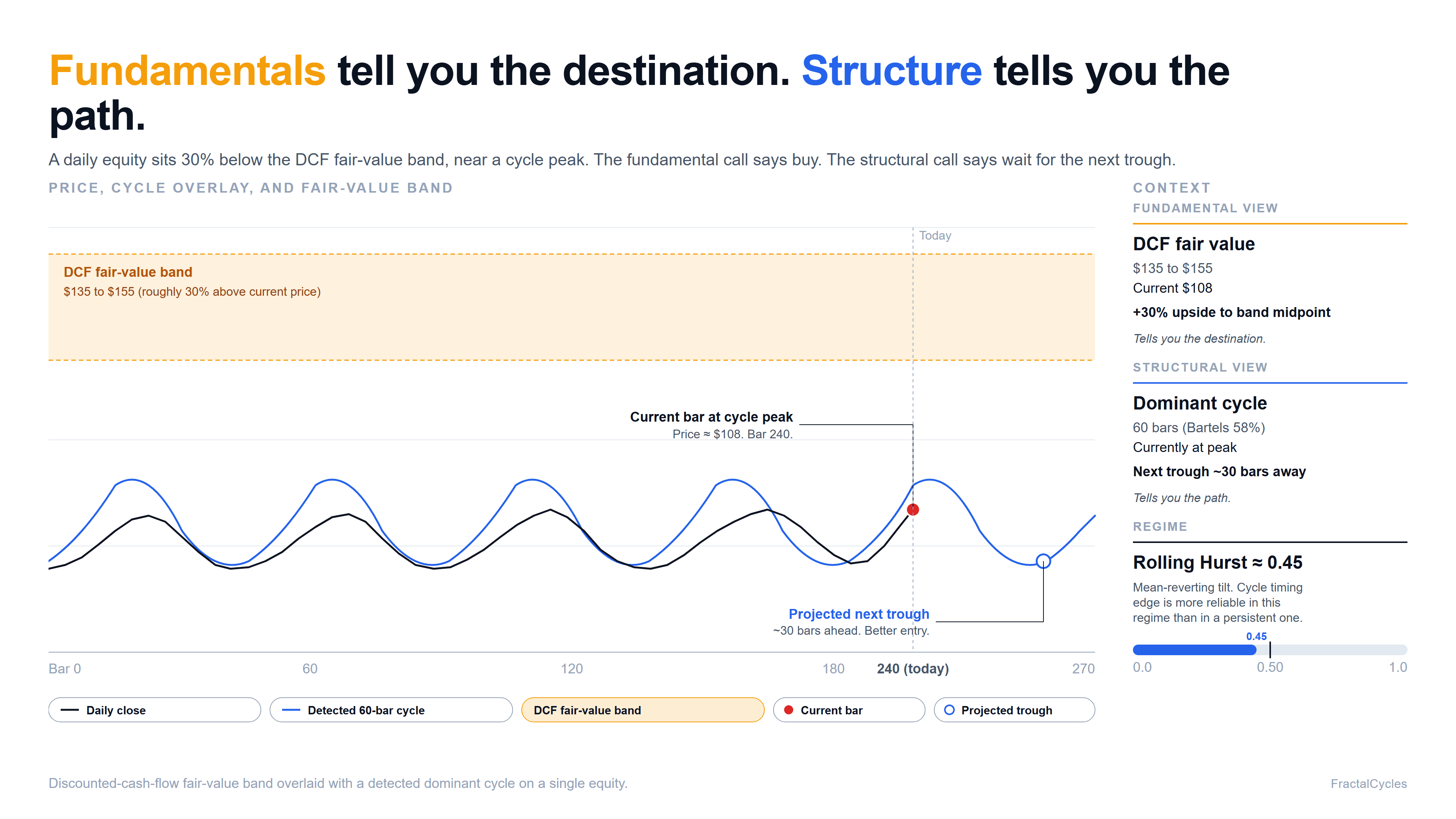
Consider an illustrative equity where a discounted cash flow exercise produces a fair-value band roughly 30% above the current price. Structural analysis on the same series identifies a dominant cycle near 60 bars on a daily chart, and the current bar sits close to the cycle peak with the next projected trough roughly 30 bars away. A purely fundamental reader sees a discount to value and buys. A purely structural reader sees an extended cycle and waits.
Neither read is complete on its own. The fundamental call is correct about the destination, the price band the asset should trend toward over a long horizon, and gives no information about the path. The structural call is correct about the path, the rhythm of swings the asset tends to trace, and gives no information about the destination. A reasonable synthesis is to keep the fundamental thesis and use the structural view to time the entry, accepting that the trough projection may slip and that the regime classification matters too.
When the rolling Hurst exponent on the same instrument reads near 0.45, the synthesis is more reliable, because mean-reverting behavior is precisely what lets a fundamentally cheap asset oscillate back toward fair value rather than drift further from it. When Hurst reads above 0.60, the asset can stay extended in either direction for longer than a single cycle would suggest, and the structural timing edge is weaker. Readers who want the regime mechanics can review the Hurst exponent guide and understanding market cycles, and a related framing appears in cycles vs narrative analysis.
Framework: This analysis uses the Fractal Cycles Framework, which identifies market structure through spectral analysis rather than narrative explanation.
Written by Ken Nobak
Market analyst specializing in fractal cycle structure
Get the Monthly Market Cycle State Report
Free market cycle data for 20+ instruments. Dominant periods, regime shifts, and phase transitions delivered every month.
No spam. Unsubscribe anytime.
Disclaimer
This content is for educational purposes only and does not constitute financial, investment, or trading advice. Past performance does not guarantee future results. The analysis presented describes observable market structure and should not be interpreted as predictions, recommendations, or signals. Always conduct your own research and consult with qualified professionals before making trading decisions.