Bitcoin topped in early October 2025, inside the window indicated by the dominant ~267-day cycle detected in FractalCycles' spectral analysis of BTC-USD daily data. That same cycle now projects its next major trough in the October/November 2026 window. The structural data through April 2026 remains coherent, which is consistent with the cycle continuing to govern price behaviour. None of this is a guarantee. It is a structural projection that holds only while the underlying cycle does.
The 267-Day Cycle: What It Called and What It Projects
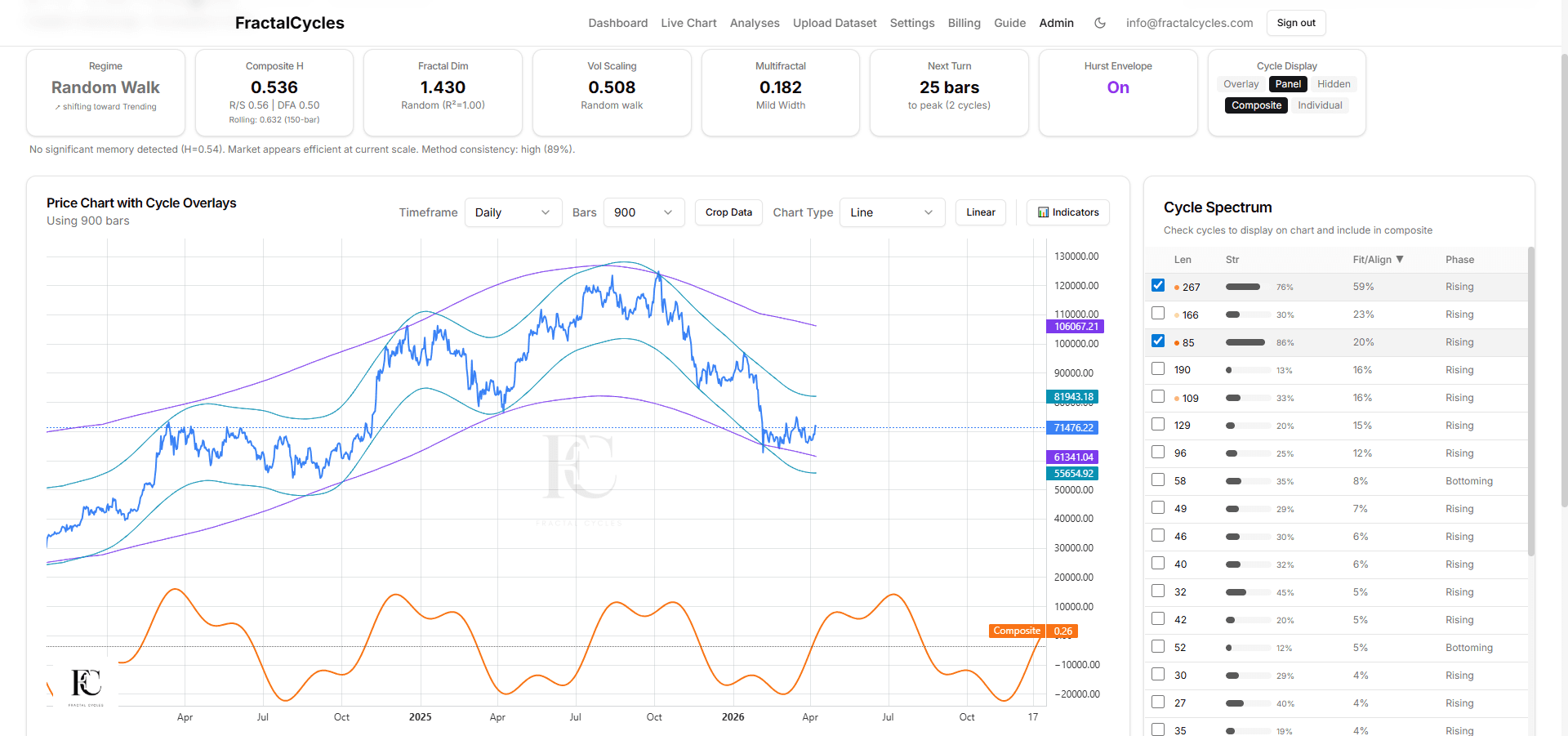
Running Goertzel spectral analysis on 900 daily bars of BTC-USD, the 267-day cycle stands out as the dominant structural rhythm. At 76% strength and 59% fit/alignment, it captures the broad swing structure that has governed Bitcoin's price action across the entire lookback window. The 85-day cycle (86% strength, 20% fit) adds shorter-term oscillation detail, showing the counter-trend bounces within the larger declining structure.
Look at the composite wave in the chart above. The orange wave in the bottom panel traces the projected path of these two cycles combined. The major historical turns identified in our internal pilot, including the November 2021 peak, the November 2022 post-FTX low, and the 2025 top, sit on or near the composite path. The early October 2025 top arrived inside the window where the 267-day cycle projected its peak. The dominant cycle is now in its rising phase toward a projected mid-2026 peak before it turns down toward the late-2026 trough. That is the structural sequence the projection implies, not a straight-line decline.
That trough is projected for October/November 2026. This is where the 267-day cycle reaches its low point. If existing cycles do not break, that is where we expect this correction to bottom.
Two Cycles, One Story
The cycle spectrum panel shows 26 detected cycles ranging from 6 to 267 days. The 267-day cycle ranks highest by fit/alignment at 59%. The 85-day cycle, with 86% spectral strength, is the second selected cycle. Together they tell a clear story: the 267-day rhythm defines the macro structure while the 85-day cycle produces the shorter swings visible in price. Both are currently in "Rising" phase. The dominant 267-day cycle is rising toward a projected mid-2026 peak; the late-2026 trough comes after that peak, not in continuous decline from here.
The October 2025 Top Was Not an Anomaly
When Bitcoin peaked in early October 2025, social media was still broadly bullish. The halving narrative, which projects a peak 12-18 months after each halving event, suggested the run should continue into early 2026. Many expected $150,000 or higher. Instead, price reversed and began declining.
The 267-day cycle's peak projection sat inside the window when the actual top printed. The fact that this contradicted the popular narrative does not make it anomalous. In this case, the cycle structure proved more consistent with what unfolded than the halving-narrative timeline did. The broader pattern: narrative frameworks predict what people want to happen, while cycle structure measures what the data actually shows.
The Anatomy of a Cycle Trough
Cycle troughs in any asset have a consistent psychological signature. Prices have been declining for an extended period. The dominant mood is bearish. Explanations multiply: macro headwinds, regulatory threats, institutional selling, manipulation. Each explanation may contain partial truth, but none of them predicted the trough before it arrived, and none of them will predict the recovery when it begins.
The 267-day cycle is currently rising toward its projected mid-2026 peak; the late-2026 trough sits roughly six months beyond that peak. The Hurst Envelope (cyan bands in the chart) shows price trading in the lower half of its structural channel, consistent with where price tends to sit ahead of a cycle peak that follows a deep correction. The structural sequence is rise into mid-2026, then descent into the late-2026 window.
What Distinguishes a Trough from a Crash
Both a cycle trough and a structural breakdown involve declining prices. The distinction lies in what the frequency domain shows. In a cycle trough, the power spectrum continues to show energy concentrated at the same cycle periods that have driven price behavior throughout the analysis window. The structural frequencies remain intact, only the phase has moved to the low point. In a structural breakdown, spectral coherence degrades: cycle periods shift, Bartels significance scores collapse, and the power spectrum flattens toward noise.
Through April 2026, Bitcoin's spectral structure remains coherent. The 267-day cycle retains 76% strength and 59% fit/alignment. The 85-day cycle maintains 86% strength. Nothing in the frequency domain so far suggests this correction is anything other than a phase within an intact cycle. The cycles that projected the October 2025 top are the same cycles projecting the October/November 2026 trough. If you found the October 2025 top projection useful, the same data and the same cycle generate the October/November 2026 trough projection.
The Manipulation Narrative: An Evidence Problem
"The market is being manipulated" is the default explanation when price moves contradict a held view. It is unfalsifiable, requires no data, and can be stated with any level of conviction regardless of evidence. It has been the dominant explanation for every major Bitcoin correction since 2013.
Cycle analysis does not deny that manipulation exists in any market. But manipulation does not eliminate cyclical structure; if anything, it amplifies cycle extremes by accelerating selling or buying near natural turning points. The structural question is not whether manipulation exists. It is: does the price data, examined through a rigorous frequency-domain lens, show evidence of cycle breakdown? For Bitcoin in April 2026, the spectral structure remains coherent and behaviour is in line with the projected structure.
Historical Precedent: 2018, 2020, 2022
Each of Bitcoin's major declines has attracted the same narrative framework:
- 2018: Bitcoin fell ~84% from its 2017 peak. At the trough, manipulation and "death of crypto" narratives dominated. The long cycle structure remained coherent throughout the decline; the trough preceded a multi-year recovery.
- 2020: The COVID crash produced an ~60% decline in days. Cycle structure, briefly disrupted by the macro shock, reasserted within weeks. The trough at $3,800 proved to be the starting point for a move to $65,000.
- 2022: A ~75% decline from the 2021 peak, accompanied by the collapse of FTX and multiple crypto institutions. The structural cycle bottom detected at the time, approximately November 2022, proved accurate. Manipulation narratives peaked at the exact trough.
In each case, cycle structure identified the trough environment while narrative analysis declared a permanent breakdown. The current decline follows the same pattern. The 267-day cycle's top projection coincided with the actual top. Its trough projection now points to the late-2026 window. Whether that trough lands inside the projected window is the structural question; the narrative-driven "permanent breakdown" framing is the unfalsifiable one.
Detect Bitcoin's hidden cycles
See which cycle periods are statistically significant in Bitcoin data — run a free analysis with our robust cycle detection software.
Run a free Bitcoin analysis NowThe Full Cycle Spectrum (April 2026)
The cycle spectrum panel in the analysis above shows all detected cycles from the 900-bar daily dataset. Here are the two selected cycles and notable supporting periods:
- 267-day cycle (dominant, selected): 76% strength, 59% fit/alignment. Phase: Rising. This is the structural backbone of the analysis. Its composite projection maps cleanly onto the October 2025 top and projects the major trough for October/November 2026.
- 85-day cycle (selected): 86% strength, 20% fit. Phase: Rising. The strongest cycle by raw spectral power. This shorter cycle drives the counter-trend bounces visible in current price action. Its rising phase explains why price is bouncing in the near term.
- 166-day cycle: 30% strength, 23% fit. Rising phase. A secondary intermediate cycle that adds oscillation detail within the 267-day framework.
- 109-day cycle: 33% strength, 16% fit. Rising phase. Another intermediate cycle contributing to the short-term structure.
- 58-day cycle: 35% strength, 8% fit. Bottoming phase. One of the few cycles approaching its low, consistent with the short-term volatility compression visible in recent price action.
The key observation: nearly every detected cycle is in "Rising" phase. This alignment of shorter cycles rising within the declining phase of the dominant 267-day cycle is what produces the counter-trend rallies that confuse participants into thinking the correction is over. It is not. The shorter cycles bounce, price follows for a few weeks, then the dominant cycle reasserts its downward pressure.
Detrended View vs. Raw Price
One reason cycle analysis diverges so sharply from narrative analysis is the detrending step. Raw Bitcoin price shows a dramatic decline from peak to current levels, and this raw decline is what drives narrative formation. Humans are wired to extrapolate recent trends.
The detrended view, after removing the long-term trend component, shows something different. The oscillatory component is on expected behavior for this phase of the cycle. What appears as crisis in raw price terms appears as a normal declining phase in detrended terms. The magnitude of the raw decline is largely a function of the amplitude of the prior bull move, not evidence of structural collapse.
What This Analysis Cannot Tell You
Structural cycle analysis is not a trading signal, a price target, or a prediction. It describes where price is in a measurable structural rhythm. It identifies whether cycle coherence is intact or degrading. It does not tell you exactly when recovery begins, how far prices will move, or whether a black swan event will disrupt the structural pattern.
What it can tell you, as of April 2026: the 267-day cycle that projected the October 2025 top is intact, coherent, and projecting its major trough for October/November 2026. The 85-day cycle is producing temporary bounces within that declining structure. The spectral framework has not broken. If existing cycles hold, the bottom is still ahead.
Running Your Own Analysis
The analysis described here is replicable. Bitcoin daily data is freely available. The Goertzel algorithm, Bartels testing, and Hurst exponent calculations can be applied to any price series. FractalCycles provides this analysis pipeline for any asset you upload. You can verify or challenge every claim made on this page by running the same data through the same tools.
That is the difference between structural analysis and narrative commentary. One is testable. One is not.
Framework: This analysis uses the Fractal Cycles Framework, which identifies market structure through spectral analysis rather than narrative explanation.
Written by Ken Nobak
Market analyst specializing in fractal cycle structure
Get the Monthly Market Cycle State Report
Free market cycle data for 20+ instruments. Dominant periods, regime shifts, and phase transitions delivered every month.
No spam. Unsubscribe anytime.
Disclaimer
This content is for educational purposes only and does not constitute financial, investment, or trading advice. Past performance does not guarantee future results. The analysis presented describes observable market structure and should not be interpreted as predictions, recommendations, or signals. Always conduct your own research and consult with qualified professionals before making trading decisions.